A Website for Your Clinic: What Patients Look For Before They Call
A guide for clinic and medical center owners in Saudi Arabia: the pages a clinic website needs, contact from a mobile phone, and how the site stays correct after launch
Read moreA practical guide for company owners and senior staff in Saudi Arabia: how to choose a first use of AI, try it, measure it, and know what stays with your team
Start with AI from a problem that repeats in your company, not from a tool you heard about. Pick one clear task, prepare the correct information it relies on, try it with your team first, measure the result before you widen it, and leave decisions and special cases to your staff.
Every day a company owner hears about a new AI tool, signs up for one, tries it for a few days, then drops it because it changed nothing in their work.
The reason is usually one of these:
AI in a company is not a big technical project. It is a new way of doing a task you already know well, so start from the task.
Ask your team: what work do we repeat every day that takes time and needs no decision? Common examples in companies:
Pick from this list what repeats most in your company, and what loses you customers when it is late.
A small trial that works convinces your team more than a big plan that never started.
AI answers only as well as it knows. If you do not give it your company's correct information, it gives general answers or makes mistakes. So prepare before you start:
Mind your customers' data: a name, a mobile number and order details are personal data. Read Saudi Arabia's Personal Data Protection Law to know what applies to you when you collect and process them, and collect only what you need.
AI handles what repeats, but some work must stay with people:
Decide from the start when a conversation goes to an employee and who receives it, and be honest with the customer: if they ask whether they are talking to a person, they should know the truth. We wrote about this in detail for WhatsApp replies in A WhatsApp Chatbot for Your Company: When It Helps and Where It Stops.
We start with you from the task, not the tool, and we have products that complete each other for this:
No action that changes your data is carried out without your approval, and each AI employee has an account and permissions that you can switch off.
What we do not offer: we do not promise that AI does all the work alone, we do not promise results or numbers before a trial, and we do not message people who have not agreed. Our team sets it up and runs it with you, step by step.
With one task that repeats every day, such as answering repeated questions or booking appointments, with one person in charge of the trial and a number measured before and after.
No. It handles what repeats and saves the team time, but decisions, complaints and special cases stay with your staff.
Your company's correct information: services or products, the repeated questions and their answers, what it must never promise, and who updates this information.
Record where the task stands before the trial, such as how many messages get a late reply, compare it afterwards, and then decide to widen, adjust or stop.
A guide for clinic and medical center owners in Saudi Arabia: the pages a clinic website needs, contact from a mobile phone, and how the site stays correct after launch
Read more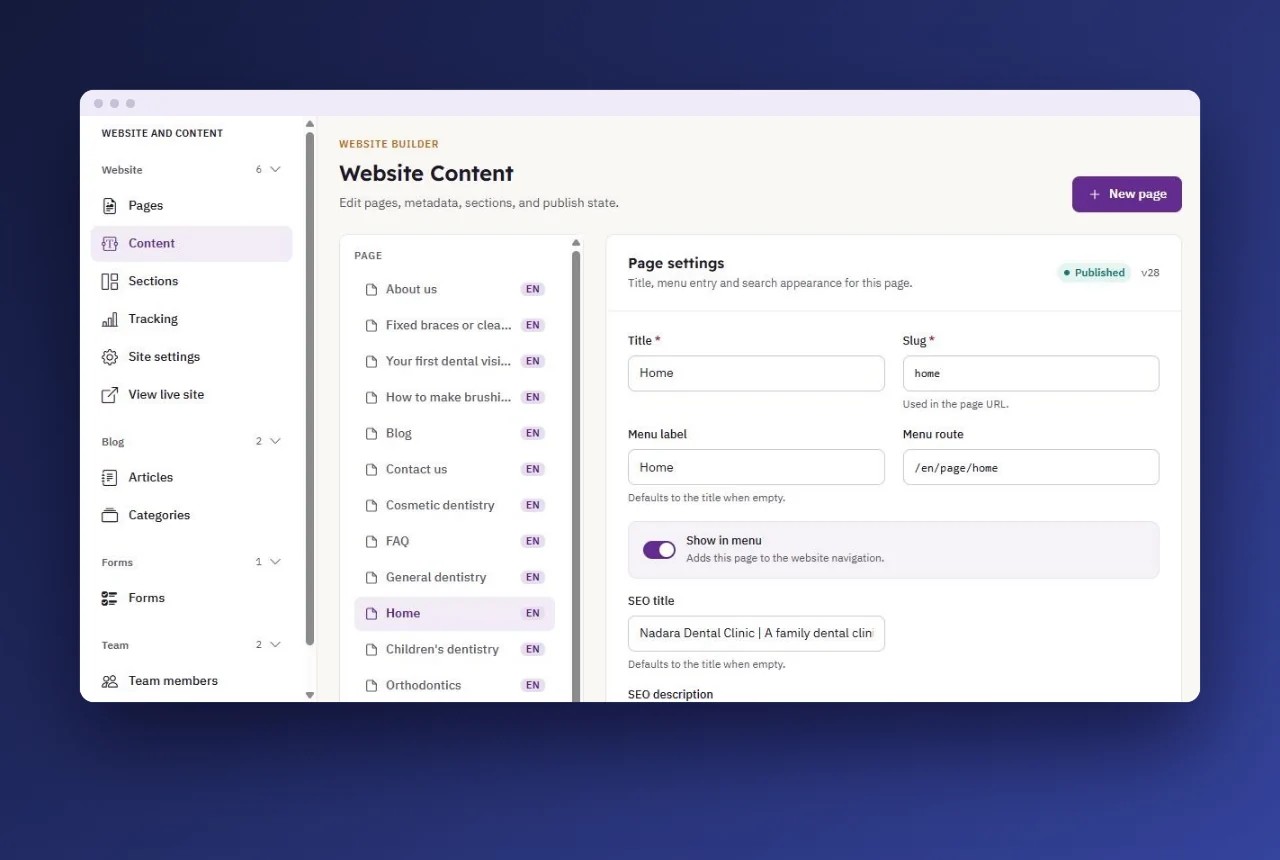
A guide for company owners in Saudi Arabia: what your team edits itself, how to assign roles and permissions, and how to separate the draft from publishing
Read more
A guide for company owners in Saudi Arabia: contact channels on the website, what to ask in the contact form, who answers and when, and how to protect the data of those who write to you
Read more